
The short answer
I built two directory sites in 2026. FuneralFinder.us grew to 13,493 pages built from scraped Google Maps data, and in its best three months it got 3 clicks from Google. WeddingVenuer.com launched with 17 pages, including 8 venue pages whose prices I checked against their sources. In its first ten weeks it got 61. Tested by us More pages didn't help. Pages with facts nobody else had put in one place did. Below: what went wrong, the six rules I carried over, and what they mean for a business website.
In April 2026 I launched a funeral home directory. By July it had 13,493 pages in its sitemap (the list of pages a site hands to Google). Google indexed about 6% of them and sent almost no one. On July 20 I typed this to my AI assistant: "We are failing the indexing war. Why?"
This is the answer, with the numbers. Both sites are mine, so weigh it accordingly. There's no client here, no revenue on either site, and one of the two still hasn't recovered.

This article covers:
- The side-by-side: both sites, the same Search Console report
- What I did on FuneralFinder, and why Google ignored it
- Six rules I carried into WeddingVenuer
- What AI writing had to do with it
- What still doesn't work
- What this means for your business site
Who this is for: anyone tempted to build hundreds of pages from a template, a list or an AI tool. That includes the business owner thinking about one page per city.
The two sites, side by side
All numbers come from Google Search Console. Tested by us
FuneralFinder.us
2clicks
13,493 pages built · about 6% ever indexed
each square = 40 pages
WeddingVenuer.com
61clicks
17 pages built · all 17 indexed
17 pages: less than half of one square
| FuneralFinder.us | WeddingVenuer.com | |
|---|---|---|
| What it lists | U.S. funeral homes | Wedding venues in Metro Vancouver |
| Launched | April 14, 2026 | August 2026 |
| Pages built | 13,493 at its peak | 17 |
| Pages Google indexed | 804 at most (about 6%) | All 17 |
| Its own early months | May 10 to Aug. 9: 5,083 impressions, 3 clicks | Aug. 18 to Oct. 24: 3,325 impressions, 61 clicks |
| Same dates, Aug. 18 to Oct. 24 | 2,441 impressions, 2 clicks, average position 73 | 3,325 impressions, 61 clicks, average position 20 |
Impressions means how often Google showed the site in results. Indexed means Google saved the page and can show it. Average position is the typical spot in results: 20 is page two, 73 is page eight.
One catch on the last row: by August I'd already started cutting FuneralFinder down, so those dates show its cleanup, not its peak. That's why the table has both rows. Either way, the result is the same. Comparable impressions, thirty times the clicks, from a tiny share of the pages.
Clicks from Google, week by week
Same ten weeks, both sites
It's not a fair fight, and I'll say why before anyone else does. The two sites cover different countries and different topics, and I believe Google holds funeral information to a higher standard. Our view This isn't a controlled experiment. It's two real projects, built by the same person, a few months apart.
What I did on FuneralFinder
The plan was simple: list every funeral home in the U.S., one page each, and earn from display ads. I used a tool called Outscraper to pull Google Maps listings city by city. By June the site had about 6,000 listings across more than 200 cities. Tested by us
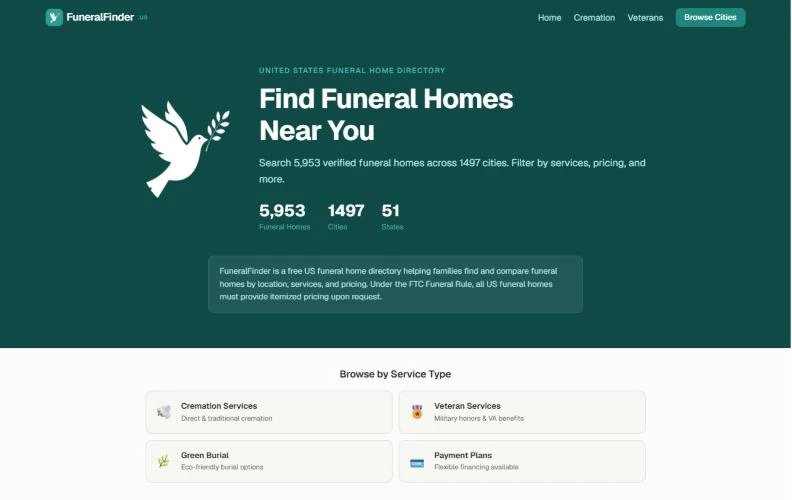
Every listing needed a description, so I had an AI write them. The prompt asked Claude for "a compassionate, factual 120-150 word description" and required "one sentence about supporting families during difficult times" in every one. Tested by us One that was still indexed in August read "compassion and respect during this challenging transition." Swap in any funeral home's name and the sentence still reads true. In June I replaced the AI text with a template built from the listing data, which wasn't much better.
Two weeks after launch, it looked like it was working: some listings ranked on page one for searches on the funeral home's own name. Impressions peaked at about 250 a day in late June. Then, within days of June 30, they fell to about 30. Tested by us
Here's what the data looked like by early July:
- Most pages never got a single impression. Of 1,497 city pages, 41 had ever appeared in a search. Of 5,988 service pages, 8 had. Tested by us
- Google stopped asking for more. Search Console showed zero pages "Discovered" and waiting to be crawled. I read that as Google deciding it had seen enough, not Google falling behind. Our view
- Three months, three clicks. From May 10 to August 9: 5,083 impressions, 3 clicks. Tested by us
The diagnosis I settled on in July: Google had judged the site as a whole, and judged it to be a copy of the Maps data anyone can buy. Our view
The fix ran opposite to the plan. On July 20 I cut the indexable site down to 61 pages. On September 7, about 5,900 listing pages started returning "410 Gone," which tells Google a page was removed on purpose. Only 18 listings stayed: the ones where I'd found the funeral home's own price list. Tested by us
Those price lists are real. U.S. funeral homes have to give itemized prices under the Federal Trade Commission's Funeral Rule. Confirmed–Industry In a five-city sample, the price of a direct cremation ranged from $675 to $3,945, nearly six times. Tested by us That's the kind of fact people search for.
But it's hard to get. Of 231 funeral home websites I checked, 33 had a usable link to their price list, and 46 blocked my scraping tool. Tested by us That's the point: if it's hard to get, it's hard to copy.
It hasn't worked yet. In the 30 days to October 24, FuneralFinder got zero clicks, and none of the 18 price pages showed up for "[funeral home] cost" searches. Tested by us Maybe it needs more time. Maybe Google still judges the site by its old version. I don't know yet.
Six rules I carried into WeddingVenuer
On July 31 I picked the next project: wedding venues, starting with Vancouver. I picked it on purpose, because couples search for prices, and a wedding venue isn't a health or money decision the way a funeral can be. Our view Then I set the rules before building a single page.
Six rules from a failed directory
What changed between FuneralFinder and WeddingVenuer
- 1Facts nobody else has put togethernot the Maps listing anyone can buy
- 2Start small and prove it80% indexed before adding more
- 3Answer the specific question“[venue] wedding cost,” not the big search
- 4A person checks every numberAI drafts, it doesn't publish
- 5No star markup you didn't collectshow ratings as text, with the source
- 6Count the hand-offclicks and calls to the business, not visitors
1. No page without facts nobody else has put together
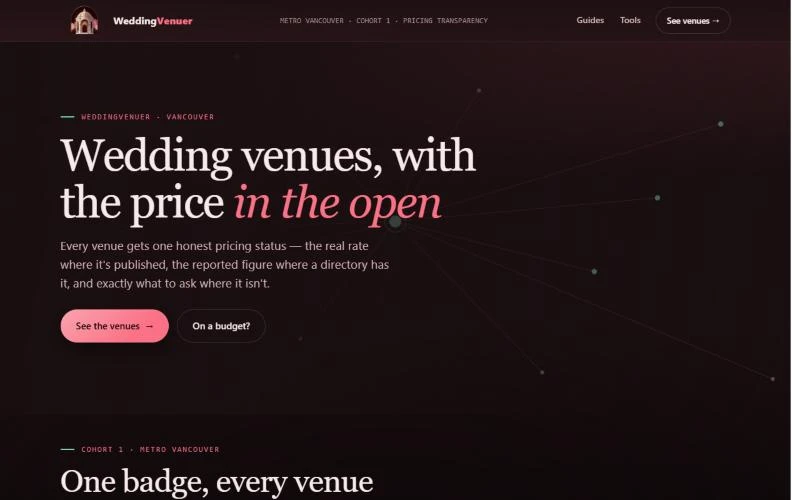
FuneralFinder's data was the same Maps listing anyone can buy. On WeddingVenuer, a venue page only goes live with a real price (the venue's own, or a third-party figure labelled as one), its capacity, its catering policy, a short write-up and a "last checked" date. Tested by us
Most venues don't make that easy. When I checked 18 Vancouver venues in August, only 6 published usable prices on their own website. None of the 8 banquet halls did. Tested by us That gap is the reason the site exists.
When this fails: when the "unique" data is something a summary can copy in one line. A price on its own isn't enough; the page has to explain what it includes.
2. Start small and prove it
FuneralFinder went to 200 cities before one city worked. WeddingVenuer launched with 8 venues. The rule: more than 80% of pages indexed within 60 days before adding the next batch. Tested by us
It passed. All the pages I'd asked Google to index were indexed within five weeks, with none stuck in "Crawled, currently not indexed." Tested by us
When this fails: when "start small" becomes "never grow." Eight venues can't compete for a broad search like "affordable wedding venues." More on that below.
3. Answer the specific question, not the big search
On FuneralFinder I chased searches like "milwaukee cremation." Those belong to the Google map listings at the top and to the funeral homes themselves. The Milwaukee page sat around position 80. Tested by us
WeddingVenuer goes after the narrow question: "[venue] wedding cost." Google hides the search behind most clicks, but of the 14 clicks Search Console could tie to a search, 12 came from searches like that, at an average position of about 10. Tested by us "Hycroft Manor wedding cost" alone sent 7. Tested by us
When this fails: when nobody searches the narrow question. Check that people actually type it before you build the page.
4. A person checks every number
On FuneralFinder, nobody read the listings before they went live. On WeddingVenuer, AI drafts each page from the venue's own rate sheets and guides, and I check every price against its source before it's published. Tested by us
It matters more than I expected. When I re-checked every venue in October, one had raised its rates within two months, and another had taken its 2027 price guide off its website. Tested by us Prices drift, so checking once isn't enough.
When this fails: when the checking stops. Keep a close eye on the dates. Every price carries one, so a reader can see how fresh it is.
5. Don't mark up star ratings you didn't collect
Both sites made the same mistake. Each one copied the businesses' Google ratings into the hidden code that asks Google to show review stars, and each one took it out after Google's tools flagged it. Tested by us Google's rules for review stars say not to aggregate ratings from other websites. Confirmed–Google WeddingVenuer now shows each venue's Google rating as plain text, with the source named. Tested by us
The same rules cover your own business site. Google won't show stars for reviews a business puts on its own pages about itself. Confirmed–Google
When this fails: when you assume an embedded review widget counts. It doesn't, even on your own site. Confirmed–Google
6. Count the hand-off
A directory works when it sends people to the businesses it lists. WeddingVenuer counts two things: taps on "Visit venue site" and taps on "Call the venue." From September 13 to October 26, 2026, that was 11 taps to venue websites, from 7 visitors, and 2 taps to call. Some of the early ones may be my own tests. Tested by us Small numbers, but they're the ones that matter. The analytics guide shows how to set this up.
I learned the other half of this rule the hard way. FuneralFinder's analytics showed 1,973 visitors over the past year. But 91% were on desktop, 43% on Linux, and almost one in five came from China, Taiwan or Singapore, for a directory of U.S. funeral homes. Tested by us That doesn't look like grieving families. Search Console, which only counts real Google searches, showed a handful of clicks. When the two disagree, trust the one that counts actions. Our view

When this fails: when a tap isn't a call. Someone can tap the button and hang up.
The problem wasn't AI writing
Both sites were written with AI. The AI text wasn't what sank FuneralFinder on its own; I'd already replaced it before the drop. But it shows the difference between the two sites better than anything else. Here's one page from each.
FuneralFinder · a listing
“…compassion and respect during this challenging transition.”
- AI was givenName, address, rating
- Checked byNobody
- Fits any competitor?Yes
WeddingVenuer · Hycroft Manor
- $9,500 food and drink minimum
- 20% service charge
- 11 p.m. hard end
- 120 seated
- 5 published fees
- 6 questions to ask
- AI was givenThe venue's price guides
- Checked byMe, against the source
- Fits any competitor?No
The first page could describe any funeral home in the country. The second only fits one venue. Our view
My position: the problem wasn't AI writing. It was AI writing with nothing to say. Give it facts nobody else has put on one page, and have a person check them. Our view The only-you test checks the same thing before you publish.
What still doesn't work
I'd be doing the same thing I criticize if I stopped at the good numbers.
- No money yet. Neither site has revenue or a paying partner. WeddingVenuer's result so far is 61 clicks and 13 taps through to venues, not income. Tested by us
- The broad searches don't rank. WeddingVenuer's "affordable venues" page sits around position 41 to 49, and the homepage barely shows up at all (26 impressions). Tested by us Sites with hundreds of venues win those searches. Eight venues can't. Our view
- One page carries the site. The Hycroft Manor page brings in about half of all clicks. Tested by us
- The price-on-request pages did fine. Two venues don't publish prices, so their pages explain what to ask instead. In September they ranked as well as most of the pages with published prices. Tested by us A price helps. What actually works is a page nobody else has made.
- FuneralFinder hasn't recovered. The rules that worked on a new site haven't rescued the old one, at least not yet.
What this means for your business site
You're probably not building a directory. But the same choice shows up on a business website, usually as "should we make a page for every city we serve?"
- Don't make a page for every city unless each one says something different. Think of a Kanata contractor with pages for Orléans, Barrhaven and Gatineau that read the same apart from the town name. That's FuneralFinder in miniature, and Google's spam policies call it doorway abuse. Confirmed–Google A French page that's only a word-for-word copy of the English one has the same problem. The local SEO guide covers what to do instead.
- Publish your prices, or explain them. People search "how much does it cost." Most of your competitors won't say. A real range, what changes it, and an example job is a page a summary can't copy. We publish ours on our pricing page. Our view
- One page per real service. Each one needs facts only you have: your process, photos of real jobs, and the permits or bylaws you deal with here. That's where the real value is. Our view
- Have a person check every number. Use AI to draft if you like. Don't let it publish.
- Count calls and form fills, not visitors. Visitors can be robots, but calls usually aren't.
When this fails: when one strong page is expected to carry a whole business. Start with your best-selling service and make that page the best answer in town.
Next step
Pick your most important service page and ask one question: could a competitor paste their name on it and use it as is? If yes, start there. The worth-the-click test gives you four more questions.
If you'd like a second pair of eyes, start with a free SEO audit. It shows how your site shows up in Google today and what to fix first.
About this page
Who: Written by Khalid Mohamed, founder of CapitalSEO. I built and run both FuneralFinder.us and WeddingVenuer.com. Neither has clients, advertisers or partners.
How: Written with AI assistance. The side-by-side figures for August 18 to October 24 come from Google Search Console Performance exports downloaded October 26, 2026. Earlier figures (indexing counts, the May to August numbers, page counts) come from each project's own records of Search Console reports at the time. Visitor and tap counts come from the Vercel Web Analytics dashboard, viewed October 26, 2026. A separate review re-checked every figure against those records. Opinions are labelled "Our view."
Why: Because the most useful thing I learned in 2026 came from a site that failed.
Published: October 26, 2026.
Sources
- Google Search Central — Review snippet (Review, AggregateRating) structured data
- Google Search Central — Making review rich results more helpful (September 16, 2019)
- Google Search Central — Spam policies for Google web search (see "Doorway abuse")
- Federal Trade Commission — Complying with the Funeral Rule
- Google Search Console Performance reports for funeralfinder.us and weddingvenuer.com (exported October 26, 2026), plus each project's earlier Search Console records
- Vercel Web Analytics for funeralfinder.us and weddingvenuer.com (dashboard, viewed October 26, 2026)